
The Headlines You Are About to Drown In
Earlier this year, an AI consultant told Axios that one of their enterprise clients ran up a bill of around US$500 million on Claude in a single month, after nobody set a usage limit. Microsoft has pulled most internal licences for a popular AI coding tool amid rising costs. Uber reportedly burned through its entire 2026 AI coding budget within months. You will see these stories, and many like them in the coming months as the “AI is too expensive” narrative fills our social media feeds.
We saw cost blow-outs and overreactions with e-commerce, we saw it with cloud, and now we are seeing it again. The first wave of hype told everyone to put AI everywhere. The second wave, now breaking, will tell everyone to pull back. Both are wrong, and the second may cost you more than the first. Pulling back or pausing progress and you squander the chance to build genuine value, handing competitors the room to pull ahead. The reality for organisations struggling with AI costs is an inconvenient truth (for frontier providers): Not every process needs AI. And, as the cost of artificial intelligence rises, we need to be smarter about how we use it to maximise impact and value.
Don’t Pause, and Don’t Retreat
Every hype cycle has its hangover: The familiar trough of disillusionment where yesterday’s miracle becomes today’s disappointment. AI has reached it, sharpened by the shift to consumption-based billing, led by Anthropic, which means every wasted call now lands directly on the invoice. The temptation is to overcorrect, to freeze spending, ban the tools and wait for the dust to settle.
Resist it. Research from Harvard Business Review and MIT highlights a persistent gap between AI investment and realised value. While many organisations have yet to achieve measurable returns, most continue to invest, recognising that benefits depend on successful scaling beyond pilots and typically emerge over time. Those that get it right see compounding advantage. However, time to value is not indefinite, with many organisations demanding demonstrable value within a defined horizon.
The smart money is not walking back initiatives. It is getting more deliberate.
The winners in 2026 will not be the biggest spenders, the loudest voices, nor the panicked retreaters.
The winners in 2026 and beyond will not be the biggest spenders, the loudest voices, nor the panicked retreaters. They will be the organisations that take control of governance, decision-making, rethink workflow to create value, and manage cost as part of that, not instead of it. If you feel behind, you are not. This discipline is still rare, which means you are not too late to build it.
A Governance Problem, Not a Technology One
We know from the early days of cloud computing, particularly the well-documented “bill shock” issues that emerged with ungoverned consumption, that strong financial controls and governance are essential to realising value from new technology. The cost stories are real, but they are rarely a technology problem. They are a problem of how we manage it. Faced with an impressive new tool, organisations default to the largest, most expensive model for every task, whether it is warranted or not. It is the corporate equivalent of using a sledgehammer to crack a walnut, then doing it ten thousand times a day.
Simply throwing money at the challenge has not bought results. Companies now plan to spend an average of 1.7 per cent of revenue on AI this year, double last year’s figure, yet Axios reports that fewer than one in a hundred organisations see a return of 20 per cent or better. A 2025 Snowflake and Ecosystm study found 81 per cent of Australian firms could not demonstrate the value of their AI investments, the second-highest rate of any country surveyed.
It is the corporate equivalent of using a sledgehammer to crack a walnut, then doing it ten thousand times a day.
Spending more has not worked. Spending deliberately might.
Protect the Space to Explore
Imagine someone saying, “we tried innovation and it doesn’t work”, because they didn’t immediately see a 10x improvement. This is where over-correction can cause real damage. In a landscape still forming, organisations need room to experiment, and experimentation looks inefficient by design. The answer is not to stop exploring. It is to know which pocket you are spending from and to set appropriate expectations.
Ring-fence a deliberate, time-boxed, cost-bound exploration budget where the return is learning, and treat it differently from production spend, where every dollar should buy a measurable outcome. Confuse the two and you will either strangle innovation or let a quiet pilot scale into a half-million-dollar bill. Governing that line is the job, and it is the opposite of stepping away from AI initiatives all together.
Right Tool, Right Problem
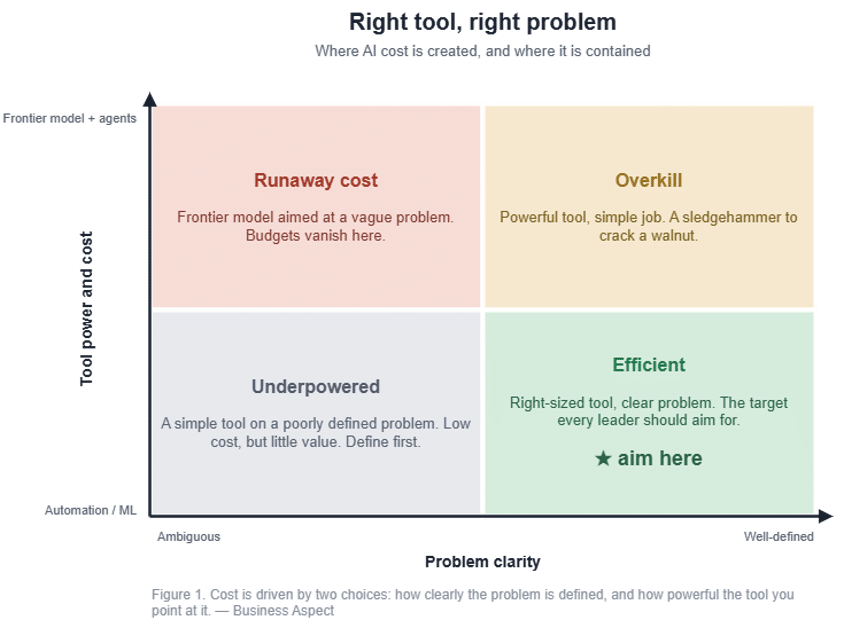
Deliberate spending starts with a question that has nothing to do with AI: what, precisely, is the business problem? This may sound strange coming from an AI expert, but it matters: not every process needs AI. Stable, rule-based work belongs to conventional automation. Pattern and prediction problems often suit classical machine learning. A frontier model and its agents should be reserved for genuinely ambiguous, language-rich, judgement-heavy work where the value clearly justifies the cost.
This may sound strange coming from an AI expert, but it matters: not every process needs AI. Stable, rule-based work belongs to conventional automation. Pattern and prediction problems often suit classical machine learning.
Figure 1 maps the two choices that drive cost: how clearly the problem is defined, and how powerful, and therefore how expensive, the tool you point at it. Well-defined problems matched to right-sized tools sit in the efficient corner; the same powerful tool aimed at a vague problem is where budgets disappear. Most organisations sit in the top-left without realising it.
The Real Test is Value, Not Cost
Cost is only the symptom. The deeper question is whether you can show what your AI is producing. Today, cloud costs are no longer opaque: Most CIOs can account for their cloud spend with precision. However, far fewer can say which AI use cases are earning their keep and which are quietly draining budget. That is not a finance gap. It is a governance gap, and it is the one that should concern every executive leader.
None of this is new. It is benefits realisation, the discipline good organisations already apply to every other investment, finally pointed at AI. And that is the catch: if you do not measure value honestly today, a cost crackdown will not save you. It will simply kick the can down the road, making the problem even bigger. The foundation is an honest view of value; cost is just the symptom that reveals whether you have one.
Five Questions Every Executive Should Ask
You do not need a technical audit to find out. You need five honest answers, scored out of a possible 10.
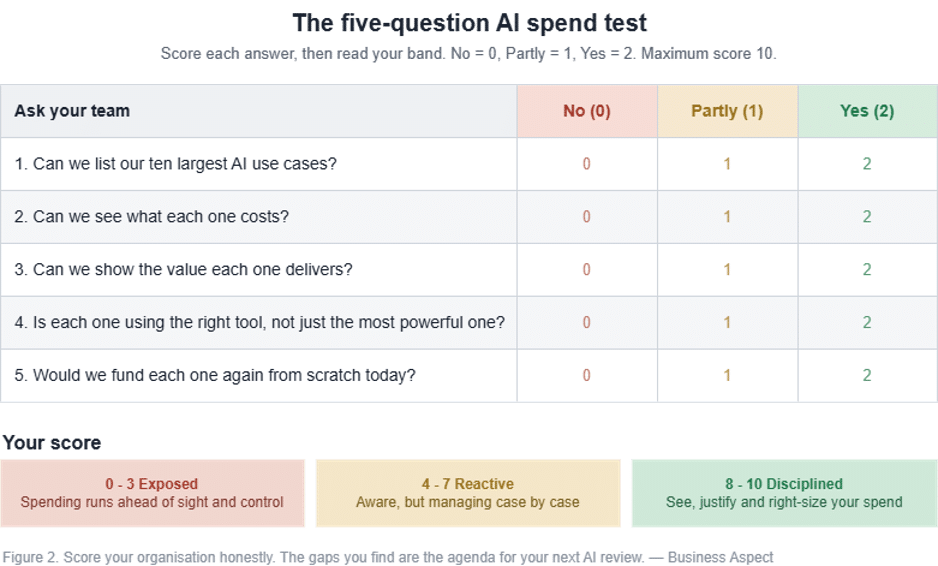
Total up your score and see where you land:
- A 0 to 3 means you are exposed: spending is running ahead of sight and control.
- A 4 to 7 means you are reactive: aware, but managing AI case by case rather than as a whole.
- An 8 to 10 means you are disciplined: you can see, justify and right-size your AI investment.
Most organisations land in the middle on a first honest pass. That is not a failure; it is simply where the work begins.
Where This Leaves You
So do not withdraw or pause, and do not be complacent. The organisations that win the next phase will move deliberately while others lurch between extremes. Take control of the governance, define the value you need, and manage the cost as you go.
This is where Business Aspect helps. We work with boards and executive teams to establish a clear, defensible position on where AI is worth the investment, through an AI Strategy and Roadmap scoped in weeks, not months. Our consultants are former CIOs, CTOs, COOs and company founders, so you work with senior people who have made these calls, not a pyramid of junior analysts. As an independent advisory firm and a Data#3 company, we have delivered AI strategy and governance work for government departments, regulators and essential services across Australia.
Start with the five questions. If they give you pause, that is the conversation to have, and you are not too late to have it.
References
- AI sticker shock hits corporate America – Axios (28 May 2026)
- AI backlash becomes a real business risk – Axios (17 May 2026)
- Anthropic squeezes enterprises by ejecting bundled tokens from seat deal – The Register (16 Apr 2026)
- Making AI Work: Strategy, Data and the Power of Ecosystems – Snowflake / Ecosystm (26 Sep 2025)
- 7 Factors That Drive Returns on AI Investments, According to a New Survey (March 2026)
- Achieving AI ROI: Insights from MIT’s GenAI Report (August 2025)
- Allianz Risk Barometer 2026 – Australia (14 Jan 2026)
- AI Agents Are Already Making Decisions in Your Organisation. Who Authorised Them? – Business Aspect (19 May 2026)
Further Reading from Business Aspect
- Leading Through AI Disruption: Strategic Guidance for Business Leaders by Dave Hanrahan.
- Maximising AI Investments: Beyond Individual Productivity by Daniel Thomas and Duncan Unwin.
- Do We Really Need Change Management for Copilot Adoption? by Deborah-Ann Allan.